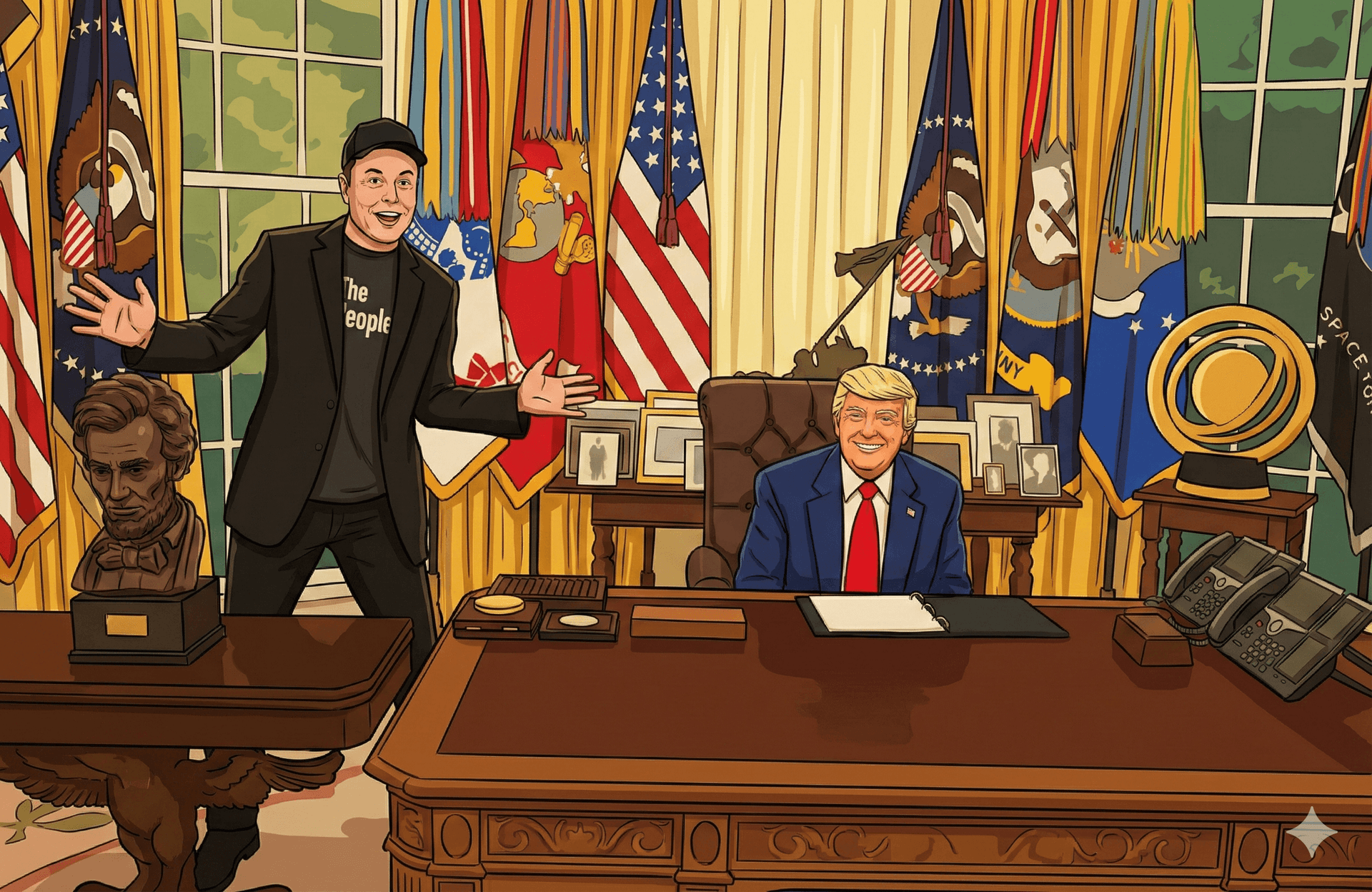
Elon Musk and Donald Trump: A Political–Business Alliance Defined by Mutual Need, Mutual Distrust, and a Grip on Each Other’s Pressure Points
 Ting Tang
 Stephany Yu
Power stories in Washington often begin with the assurance that “they won’t really fall out,” and end with the realization that “of course they will.” The relationship between Elon Musk and Donald Trump resembles a long-term procurement contract that has been revised again and again: the clauses keep changing, yet the true terms of performance are never written down. They are etched instead into each side’s degree of replaceability.
In June 2025, the White House initiated a review of SpaceX’s federal contracts. On the surface, the question was whether those contracts would be cut. Seasoned Washington observers, however, focused on a subtler signal: the review itself was a negotiating posture, a reminder that while the company mattered, it was not untouchable. Whether contracts tied to national space and defense missions would actually be affected became secondary. What mattered was that uncertainty was deliberately preserved and deployed as a political instrument.
In this story, uncertainty is not a by-product; it is the core weapon. Musk and Trump can shake hands before cameras and trade insults across social media. They can march side by side in anti-establishment narratives while remaining tightly entangled within government procurement and regulatory systems. To grasp this condition of cooperation, rupture, and continued linkage, one must look beyond personality and toward structural contradiction.
I. The Transactional Honeymoon: Using Each Other as Amplifiers
To frame the Musk–Trump alliance as a “community of values” is largely a literary flourish. To see it as an exchange of influence comes closer to political-economic reality.
Trump needed the endorsement of technological capital and platform attention to lend tangible weight to his anti-establishment narrative. Musk, in turn, needed administrative power to tilt regulatory posture, secure government orders, and gain institutional access. This logic of exchange once made the so-called “Department of Government Efficiency” (DOGE) a shared stage. For Trump, it symbolized cutting bureaucracy and disciplining government. For Musk, it functioned as an interface into federal budgets, procurement, and regulatory pipelines. That interface did not directly decide who won contracts, but it determined who embedded earlier and deeper into institutional processes.
The contradiction was obvious: one side chanted “shrink government,” while the other reaped material benefits from rocket launches, satellite internet, vehicle subsidies, and AI contracts. The rhetoric of downsizing government began to overlap with the reality of controlling critical national infrastructure. This was no longer classic crony capitalism. It looked more like an outsourcing of state capacity: the government drew on entrepreneurial technology and efficiency, while entrepreneurs fused innovation narratives with national-competition narratives to secure looser regulation and steadier cash flows.
II. The Logic of the Break: When Fiscal Politics Collide with the Myth of Efficiency
The rupture did not stem from personal animosity, but from the incompatibility of two victory narratives.
Debates over tax and spending legislation in 2025 exposed this structural tension. Musk’s business empire rests on a myth of efficiency—compressing costs, shortening cycles, applying engineering logic against bureaucratic inertia. Trump’s large fiscal packages, by contrast, were highly politicized redistributive instruments, aimed primarily at electoral mobilization rather than process optimization.
When Musk publicly criticized such legislation for betraying the promise of “streamlining government,” the conflict escalated rapidly. One White House insider later recalled that these statements touched “not budget numbers, but the integrity of a political narrative.”
The ensuing talk of “canceling contracts” or “grounding Dragon spacecraft” was not an operational plan but a public marking of bargaining positions. Musk underscored his own indispensability; the government replied by activating institutional review to signal that reliance did not equal loss of control.
This was not a moral dispute but a contest of leverage. One side said, “I supply critical capabilities.” The other answered, “I hold procurement and regulatory authority.” At the same time, it functioned as a national-security stress test: when the state depends heavily on a handful of firms for essential functions, it must demonstrate that constraint mechanisms still exist.
III. Re-Linkage: Post-Emotion, Transactional Coexistence under Institutional Control
What impressed Washington veterans was not the falling-out itself, but what followed: institutions absorbed the conflict.
The public clash of June 2025 looked like an emotional personal break. Inside the White House and the federal system, however, it was quickly reframed as a risk-spillover event. The issue was not who said what, but whether the confrontation could spiral and disrupt the nation’s dependence on critical technologies and industrial capabilities.
That calculation explains why both sides ultimately stepped back.
For Trump, Musk was not an ordinary entrepreneur but a potent symbol within narratives of “government efficiency” and technological de-bureaucratization. In spaceflight, low-Earth-orbit satellites, AI, and electric vehicles, the federal government lacked true short-term substitutes. Rhetorical rupture was tolerable; institutional rupture was not. Once costs shifted from individuals to state capacity itself, restraint became imperative.
On that basis, Vice President J.D. Vance intervened, conveying a clear signal to Musk: escalating public confrontation yielded no strategic benefit to either side. The White House, meanwhile, avoided impulsive punishment. It chose review, procedure, and preserved uncertainty—not hesitation, but a classic Washington technique: strip personal conflict from the decision chain and lock indispensable capabilities back into institutional frameworks.
Behind this lay a colder assessment. Musk was neither a traditional donor nor merely an adviser or spokesperson. He was a political variable with his own platforms, supply chains, and mobilization capacity. The assets he controlled—launch capability, low-orbit satellite networks, and general-purpose AI models—were difficult to replace in the short term and had become integral to national functioning. Institutions needed these capabilities while preventing them from capturing decision-making power in return.
For Musk, sustained public confrontation with a sitting president was equally untenable. SpaceX and Starlink’s contract dependencies, Tesla’s regulatory exposure in autonomous driving, and X’s sensitivity to antitrust and communications policy all meant that once conflict entered institutional channels, consequences would exceed the realm of public opinion and slip beyond personal control.
His subsequent retreat was therefore measured. He quietly reopened communication channels, then issued a vague, non-explanatory expression of “regret” that lowered the temperature without fully retracting his stance or escalating further. This was not capitulation, but recalibration: under conditions of deep institutional dependence, continued confrontation only hastens the trigger of formal constraints.
Trump responded with the posture of “focusing on national affairs rather than personal grievances.” The subtext was not magnanimity but boundary-setting: de-escalation was acceptable; the relationship would revert to a cool, transactional coexistence. Emotions could cool; functions had to remain.
This logic soon manifested in institutional operations. In 2025, the U.S. General Services Administration, citing federal IT procurement reform law, added xAI’s Grok model to the list of AI tools eligible for federal purchase and promoted its adoption under relatively permissive conditions. Officially, this was framed as part of a broader federal AI strategy, unrelated to personal relationships. The timing, however, was symbolic: personal tension persisted, but the machinery of government had resumed normal function.
That is the real meaning of “re-linkage.” It is not emotional reconciliation but functional re-embedding. Once a capability is deemed usable, effective, and hard to replace, the system continues to call upon it, regardless of personal animosity. Political rifts may persist, but they do not automatically sever state dependence on key capacities.
The post-conflict relationship never returned to a “honeymoon.” Open hostility ceased, replaced by a colder transactional coexistence. Musk curtailed direct attacks and reengaged with pro-government circles. Trump preserved policy latitude without public threats. Both understood that trust was not restored; risk had merely been repackaged.
Personnel shifts at NASA became the most controversial and symbolic episode of this phase. Trump renewed efforts to appoint Jared Isaacman as NASA administrator. Isaacman’s close collaboration with SpaceX led critics to read the move as a political concession to Musk. Officially, it was defended as an industrial strategy emphasizing commercialization, Mars prioritization, and rapid iteration—not personal reward. Even if it did ease tensions, it was embedded within a defensible institutional logic.
The same logic applied to contracts and policy. Trump neither could nor did simply “gift” contracts to Musk. Yet the policy environment shifted structurally: Starlink was re-included in competition pools for broadband projects worth tens of billions of dollars; space, defense, and communications policy tilted toward commercialization and rapid deployment—areas of structural advantage for the SpaceX ecosystem.
This tilt was not unconditional. Procurement remained subject to law, competition, and congressional oversight. Counter-legislation aimed at curbing “Musk’s gains” began to circulate. Uncertainty was intentionally retained as an institutional check on the super-entrepreneur: drawing on his capabilities while preventing their rebound against the power structure itself.
IV. The External Front: When Corporate Disputes Become Nationalized
As domestic tensions simmered, the external front provided a new adhesive for alignment. When the European Union fined X under the Digital Services Act, the dispute was quickly elevated into transatlantic political friction. The penalty ceased to be a regulatory matter alone and was framed instead as systemic pressure on U.S. technology platforms and free speech.
Senior officials moved swiftly to take sides, converting compliance disputes into geopolitical narrative. This is a familiar technique of power: when internal differences resist resolution, external pressure can temporarily realign internal coalitions. It was not reconciliation, but a recalibration of interests.
V. Ideological Packaging: From Technical Narrative to Political Engineering
If the preceding sections examined how power is traded and constrained, this one asks how power is concealed.
Musk’s most influential—and most contentious—asset is neither capital nor platform, but a technological narrative readily absorbed by institutions. He persistently frames engineering pathways as a seemingly “non-political” worldview: abundance over scarcity, supply expansion over distributive conflict.
In Tesla’s Master Plan, “abundance” is enshrined as a long-term vision. This is not idiosyncratic rhetoric but aligns with Silicon Valley’s increasingly mainstream “abundance agenda”: expand supply through technology to sidestep debates over trade-offs, redistribution, and social conflict. Its essence lies not in policy positions but in redefining what counts as a problem and what need not be discussed.
The danger lies in its surface neutrality. When technology is portrayed as naturally resolving scarcity, politics is repackaged as engineering: approvals become bottlenecks, regulation becomes friction, and value conflicts collapse into efficiency deficits. Highly political choices are rendered as rational, objective, and inevitable system outputs.
More importantly, this language is being institutionalized. In AI governance and federal tech procurement, terms like “ideological neutrality” and “de-biasing” are written into policy texts, translated into algorithmic standards and administrative principles. Judgments born of Silicon Valley culture are embedded into infrastructure and execution, removed from sustained public debate.
Ideology does not vanish in this process; it changes form. It no longer appears as slogans, but operates through parameters, process design, and system defaults. The real question is not any single stance, but how democratic societies recognize and respond when politics is successfully reframed as “merely a technical issue.”
Conclusion: Not Gossip, but an X-Ray of Institutions
To treat the Musk–Trump relationship as reality television yields only emotion. To view it as an X-ray of governance reveals deeper transformation.
As states grow more dependent on a small number of firms for critical capabilities, the boundary between public and private must be rewritten. As entrepreneurs command industry, platforms, and narrative power simultaneously, politics inevitably shifts toward transaction and bargaining. Supporters argue that amid great-power competition and administrative sclerosis, technocratic governance may be less an erosion of authority than a pragmatic patch to state capacity.
Falling-outs are often just another form of negotiation; cooperation is usually a temporary alignment of interests. The significance of this relationship lies not in the two men themselves, but in what it prematurely exposes: a power structure in formation, where corporations are built into national infrastructure and politics itself is run as personal branding—probing and constraining each other on the same board.
Sovereignty is no longer written solely in constitutional text. It is being redrawn across system interfaces, technological dependencies, and institutional bargaining.