The Funeral in Davos
 Ting Tang
 Stephany Yu
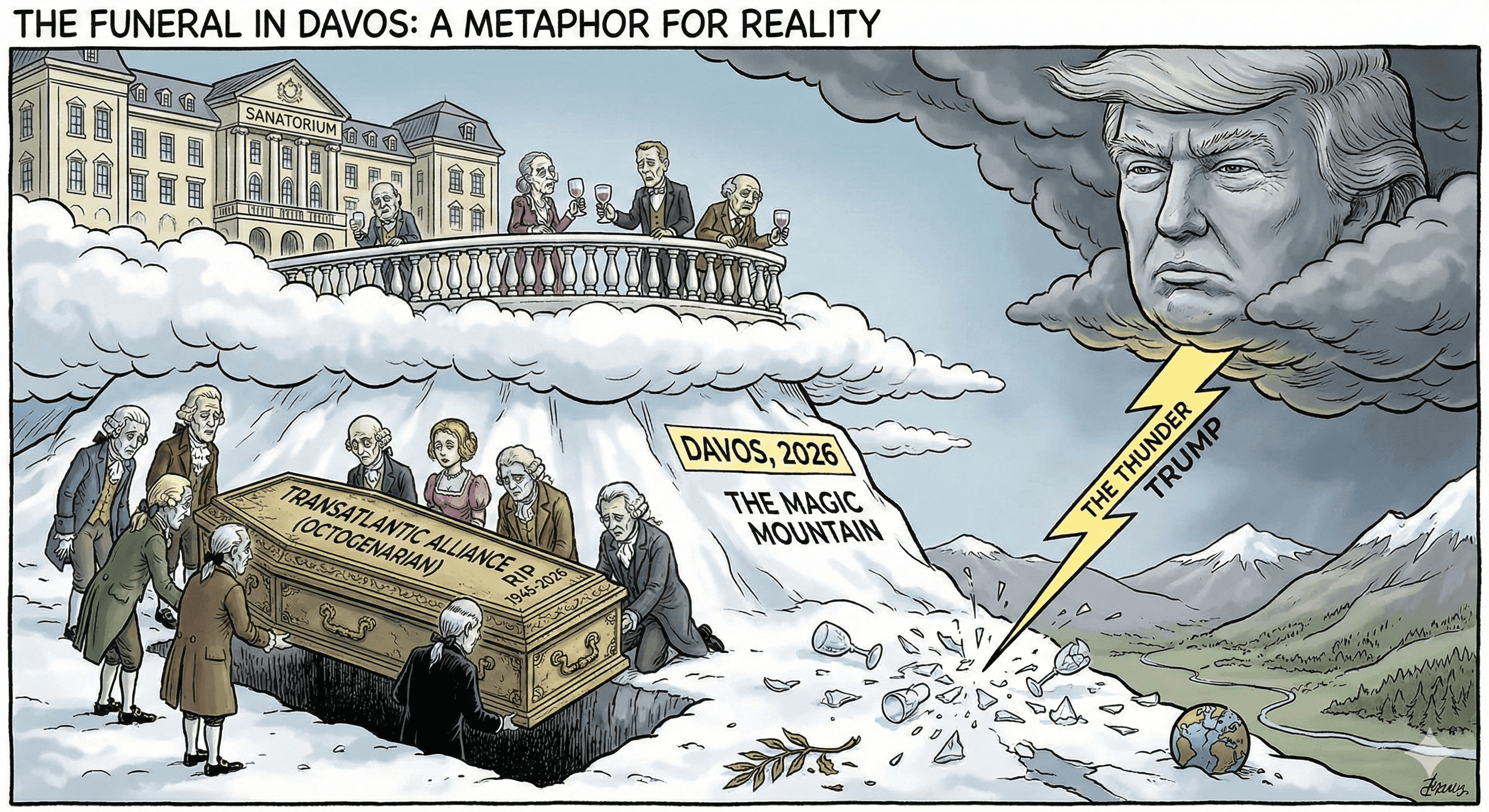
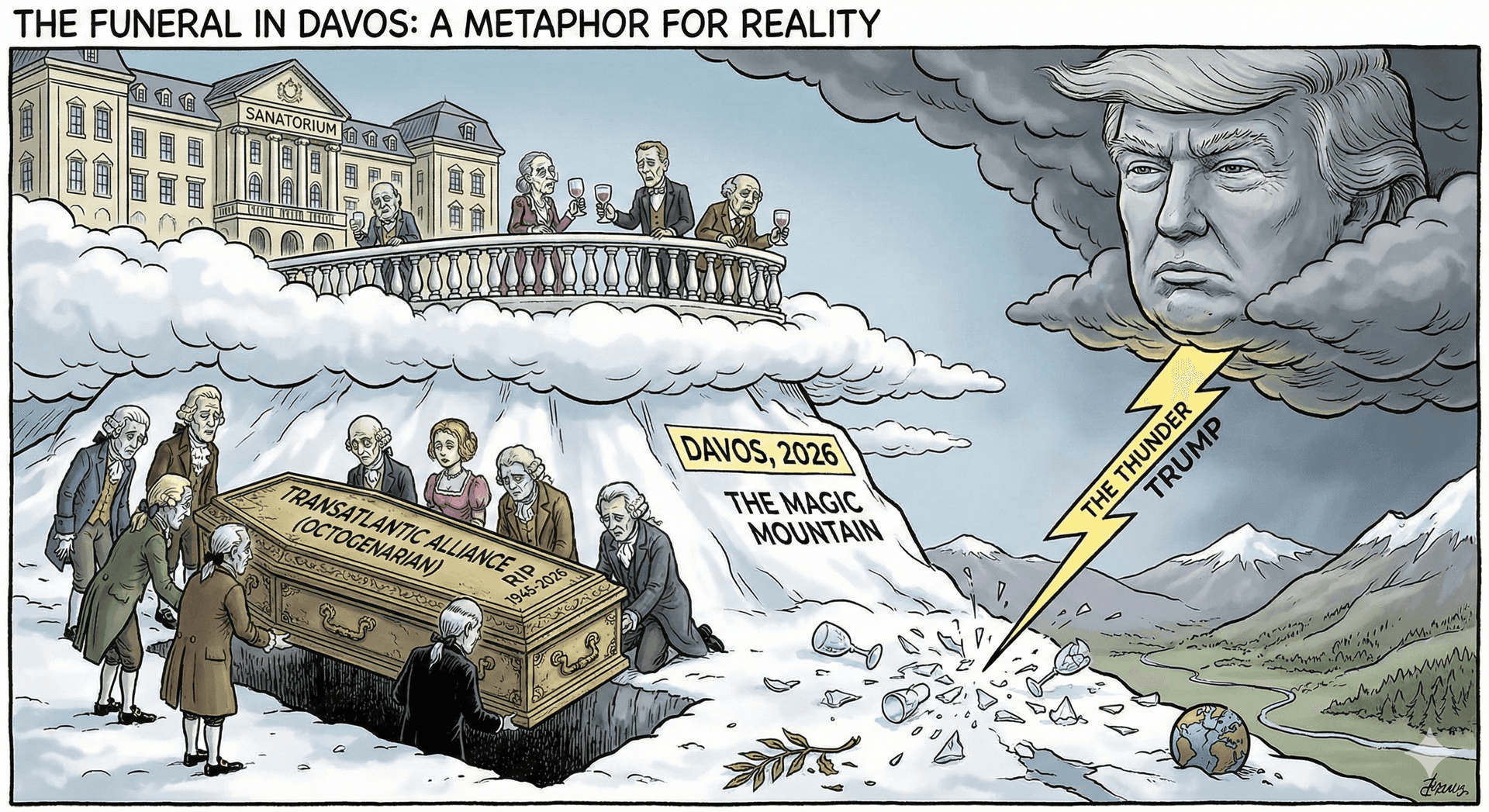
It was a meticulously choreographed funeral, yet the occupant of the coffin was not a person, but an octogenarian known as the "Transatlantic Alliance."
In Davos, 2026, the Alpine air remained thin enough to induce hypoxia—a fitting match for the sense of unreality permeating the atmosphere. Thomas Mann’s The Magic Mountain has once again become a metaphor for reality: a coterie of terminally ill old aristocrats, sequestered in a sanatorium above the clouds, discoursing on some noble eternity until the thunder from the valley below shattered their crystal goblets.
Donald Trump was that thunder.
This time, he arrived without the salesman-like braggadocio of 2018, nor the campaigner’s desperation of 2020. Having returned to the White House a year ago, he ascended the podium—regarded by the globalist elite as a sacred altar—with the arrogance and ennui of a landlord coming to collect rent. He was not there to negotiate. Negotiation is charity granted to equals. Faced with European allies who had long since emasculated themselves amidst energy crises, stagnant growth, and bureaucracy, Trump was there to deliver a verdict.
The Europeans, still clad in impeccably tailored suits and clutching glossy reports on carbon emissions and ESG (Environmental, Social, and Governance), attempted to tame the beast with civilized etiquette. It was an exercise in wishful thinking. Long immersed in a sense of moral superiority within the conference rooms of Brussels, they had forgotten the foundational logic of human history: without the backing of power, morality is nothing more than an empty incantation.
Trump’s Davos address this year stripped away that fig leaf entirely.
From the stage, he spoke of the American energy boom, the security of sealed borders, and the federal bureaucracy he had personally dismantled. Every word was a slap in the face to the Macrons (though he had departed early in a rage) and the Scholzes of the room. While Europe squabbled over the definition of "green hydrogen," the United States had reforged its industrial heartland through shale oil, natural gas, and deregulation. This is not a policy divergence; it is speciation. America is reverting to the form of a wild bison—bloodthirsty, rapacious, yet teeming with vitality—while Europe has devolved into a greenhouse orchid: delicate, beautiful, and utterly incapable of survival in the wild.
A close observation of the European leaders in the audience revealed a complex psychological landscape: the disdain of faded aristocracy confronting a nouveau riche upstart, overlaid with a bone-deep terror—the realization that they have not only lost the estate but can no longer afford the butler.
Trump no longer spoke of "shared values." That phrase, which once cemented the Western world upon the ruins of World War II, has cracked and peeled away. He spoke of the ledger. NATO protection fees, trade deficits, tariff barriers. His logic was as cold as a scalpel: if you desire the protection of the Roman legions, you must pay the provincial taxes. Since you insist on hobbling America with automotive and data regulations, then everyone—from Frankfurt bankers to Bordeaux vintners—must prepare to bleed.
It evokes the scene from The Godfather featuring Michael Corleone in his Nevada estate. The family business has moved on; old debts have been settled. For those "old friends" who cannot keep pace and serve only as dead weight, all that remains is a transactional indifference. The ultimate betrayal is simply ceasing to pretend that one cares.
Once, the Atlantic was a bridge connecting two continents; now, it has become a moat. Trump stands on one side, backed by roaring factories and a feverish stock market; Europe stands on the other, cradling a bundle of obsolete treaties and nostalgia for a bygone era.
Every hegemonic transition in history is accompanied by such brutal moments. This is not merely a geopolitical fission, but the collapse of a psychological defense. The welfare paradise that Europe has long constructed under the American nuclear umbrella is, in essence, a colossal act of historical parasitism. The host is now weary—and his temper has soured.
The speech concluded, and Trump departed amidst a phalanx of Secret Service agents, leaving behind a room of silence. It was not the silence of contemplation, but the aphasia and suffocation one feels in the face of force majeure. These elites will retreat to their chalets, sip expensive wine, and complain about the old man’s crudeness and ignorance. They will employ their most biting wit to mock his hair and his tie, attempting to salvage a shred of their pitiful pride.
Yet this cannot alter the fact: in this new world where the strong devour the weak, they have just been served their final eviction notice. The snow is still falling in Davos, but the long winter has only just begun.