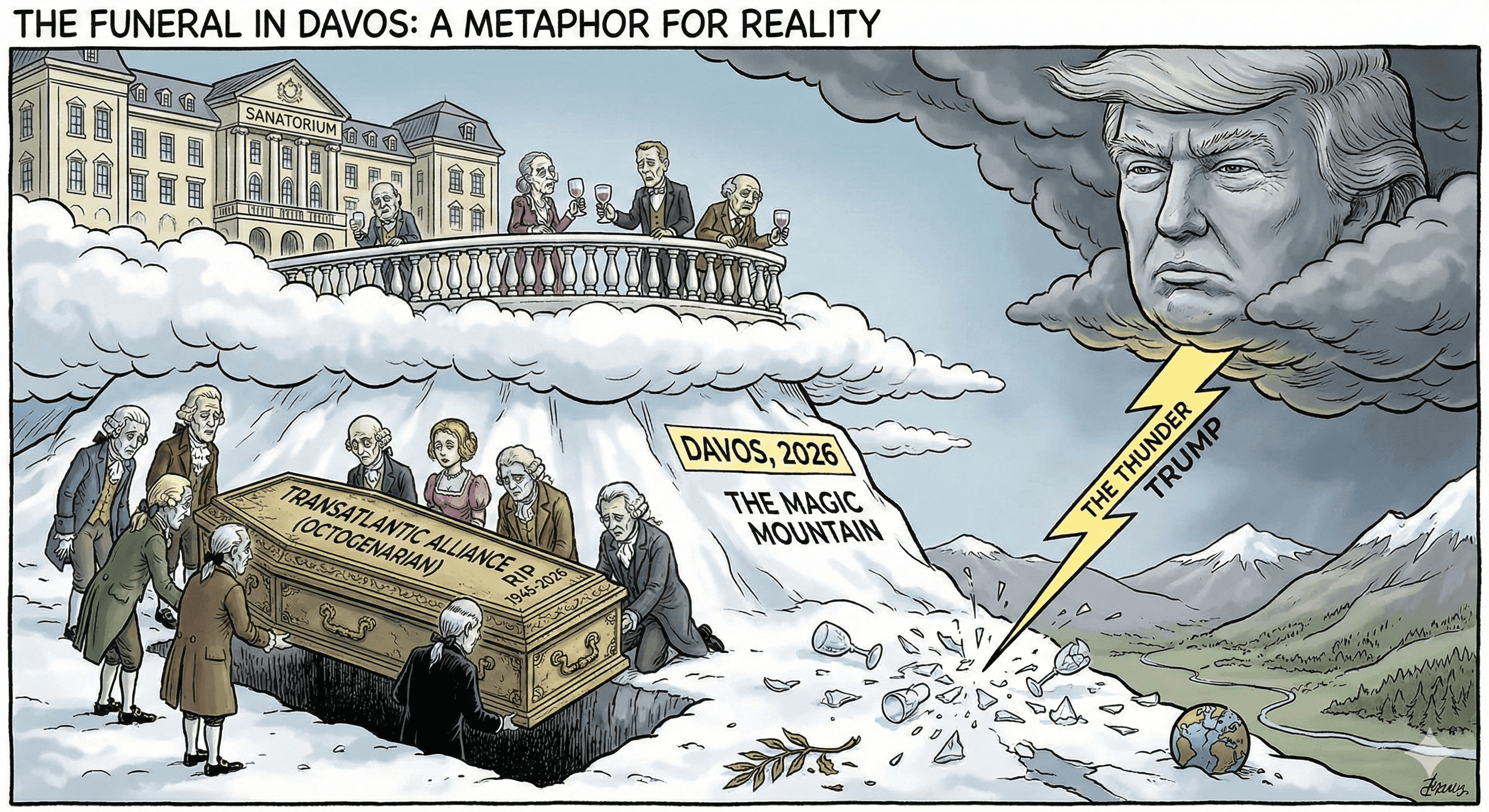
The Donroe Doctrine in the Making
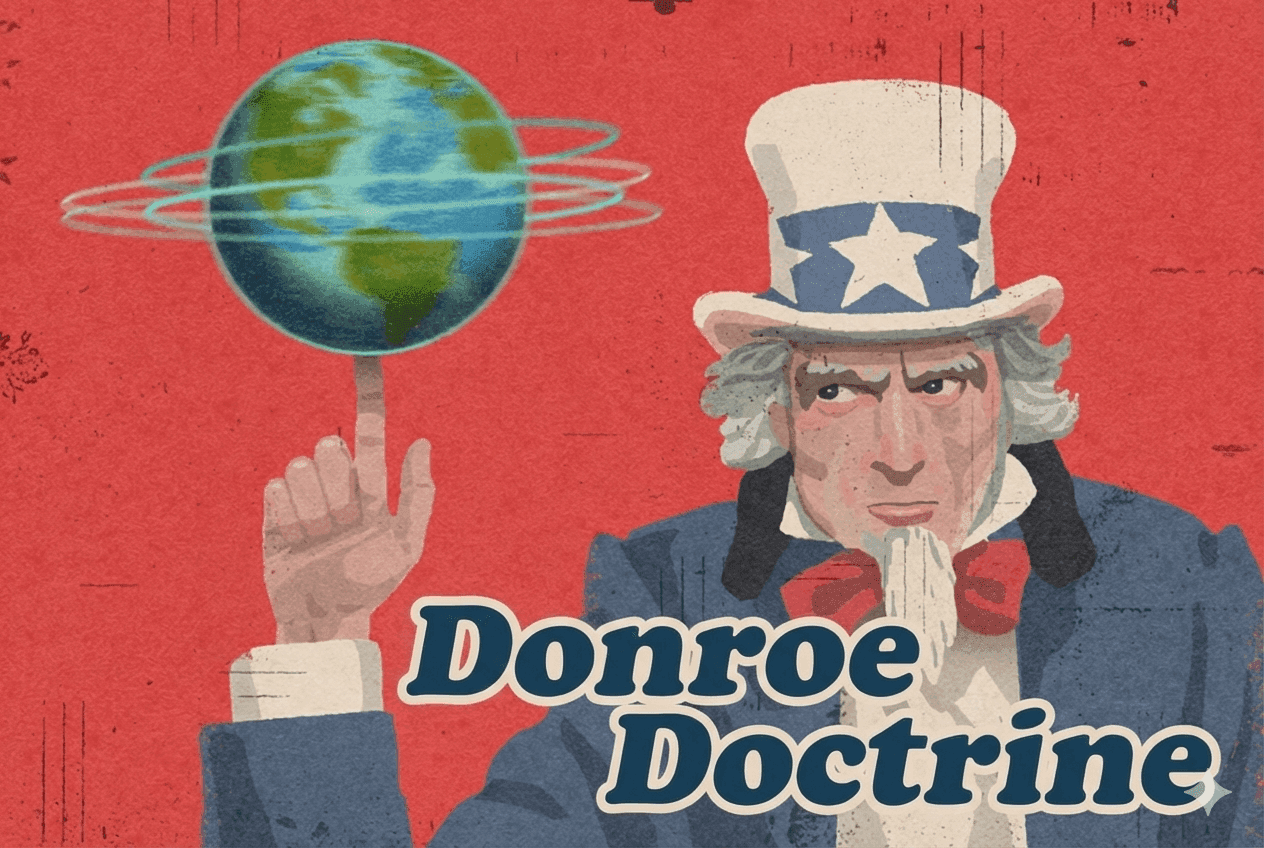
 Ting Tang
 Stephany Yu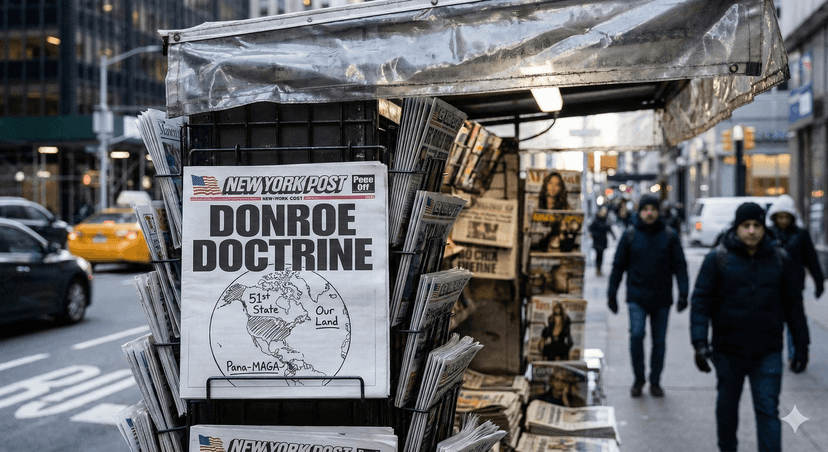
Chapter One | The Emergence of a Definition: From “Long Investment” to “Stop-Loss”
On January 8, 2025, The New York Post dropped a visual bombshell on Manhattan newsstands: a crudely marker-defaced map of the Western Hemisphere. Canada was labeled “The 51st State.” Greenland read “Our Land.” The Panama Canal became “Pana-MAGA.” Above it all, a two-word headline in bold black type landed like a stamped seal: Donroe Doctrine.
It initially resembled a media prank. But it rapidly slid into policy discourse. The term gained traction not because it introduced a novel idea, but because it precisely captured an already crystallized reality: the expression of state will was being compressed into shorter, more direct physical actions.
This logic did not begin in 2025. In January 2019, cameras in the White House briefing room caught a glimpse of National Security Advisor John Bolton’s yellow legal pad. Scrawled across it were the words: “5,000 troops to Colombia.”
It was not a Pentagon-vetted deployment plan, nor was there any congressional appropriation. It functioned more like a deliberately misplaced stage prop. Within an hour of the photograph circulating, diplomatic phone lines in Bogotá, Caracas, and Havana lit up, while traders stared at currency screens. No troops boarded ships that afternoon—but deterrence had already been transmitted.
This was the embryonic form of the Donroe Doctrine. It marked a fundamental shift in political survival logic: even as legacy institutional systems continued operating, decision-makers began searching for shorter paths.
The postwar order promised that adherence to multilateral rules would eventually pay off. By the 2020s, those returns had become distant and abstract to voters, while the costs—job losses, inflation, industrial hollowing—were immediate. In this misalignment, procedures came to be seen as delay, and patience was repriced as weakness.
Political objectives thus shifted: away from long-term allocation, toward immediate recovery.
The Donroe Doctrine is not a rigorously articulated theory. It is closer to an operations manual forged under stress testing. Its defining feature is the de-proceduralization of power. Institutions have not been abolished—the United Nations still stands on the East River—but the procedural chain is increasingly bypassed. Legitimacy no longer derives primarily from completing the full cycle of agenda-setting, consultation, and authorization, but from demonstrating execution capacity.
Under this logic, whoever can generate pressure fastest, impose costs most quickly, acquires the authority to define “effective governance.” This resembles a hostile acquisition more than a negotiation: rather than litigating in court, one prices the asset through force.
Decision radii therefore shrink dramatically. Bolton, Pompeo, and their successors formed an execution layer obsessed with speed, concentrating risk at the center of power in exchange for temporal advantage. In contemporary political markets, accusations of recklessness may still be defensible; perceptions of incompetence are fatal.
Chapter Two | The Operating Mechanism: Manufacturing “Visible Wins”
Once shifted from ideology to execution, the Donroe Doctrine reveals itself as a highly standardized tactical process. Its objective is pragmatic and clear: repeatedly produce already-realized victories within a finite political cycle. The mechanism unfolds in three steps.
Step One: Selecting “Node-Type” Targets
Not every country is worth engaging. Operators seek nodes with leverage properties within global networks.
Venezuela was no accident. Geographically enclosed and firmly within America’s traditional sphere, external intervention costs are high. Its narrative density is extreme—oil, migration, ideology—each easily convertible into domestic political material. Most critically, it is a severable system: control a handful of financial accounts and energy chokepoints, and systemic pressure follows.
Greenland and the Panama Canal follow the same logic. They are not isolated territorial issues but valves within global circulation systems. Control the valve, and one acquires veto power over flows.
Step Two: Maximum Pressure and Uncertainty Injection
Once targets are locked in, incremental diplomacy is discarded. The opening move is high-intensity.
Sanctions, evacuation advisories, military exercise signals, and personal financial freezes are released in rapid succession. This is often misread as a prelude to war. In reality, the core weapon is uncertainty, not force.
The strategy exploits psychological defenses with precision. Ambiguous yet forceful signals compel adversaries to immediately calculate worst-case scenarios. Capital flees. Assets are shifted. Militaries enter high-cost readiness. Every reaction requires real expenditure. The operator, by contrast, pays only rhetorical and administrative costs.
This is classic asymmetric gaming: forcing opponents to pay in advance for disasters that may never occur. Anxiety itself becomes extracted political yield.
Step Three: Rapid Settlement or Infinite Suspension
Following pressure, outcomes converge toward two paths—both marketable as victories.
If the opponent yields, a “settlement moment” follows. The specifics matter less than the signature, handshake, and imagery. Even if the deal collapses later, the political return has already been booked.
If the opponent holds firm, the operator avoids entanglement and shifts to infinite suspension. No regime change, no sanctions relief—just a maintained, low-intensity, controllable crisis that can be reactivated on demand. An unresolved problem becomes a stable political reservoir.
This preference is structural, not merely tactical. In Venezuela, power does not reside in a single replaceable ruler but in a heavily armed, self-reinforcing privilege network deeply entangled with illicit economies. Individuals function as nodes, not fulcrums. Even decapitation allows rapid reconstitution. Genuine endgames—systemic reconstruction, democratic transition, legal reckoning—would require prolonged occupation, social trusteeship, massive reconstruction costs, and high civil-war risk. For a political system governed by immediate settlement logic, such long-term, uncertain, and spillover-prone costs are effectively excluded.
Thus, infinite suspension is not failure but rational response to structurally insoluble problems: when time is not on your side, cut losses early.
This logic explains why, even after the arrest of Maduro, Trump continued engaging figures like Vice President Delcy Rodríguez—who controlled execution resources—rather than installing opposition leader María Corina Machado, despite her recent presentation of a symbolic Nobel Peace Prize endorsement.
Chapter Three | Historical Depth: A Century of the Monroe Doctrine
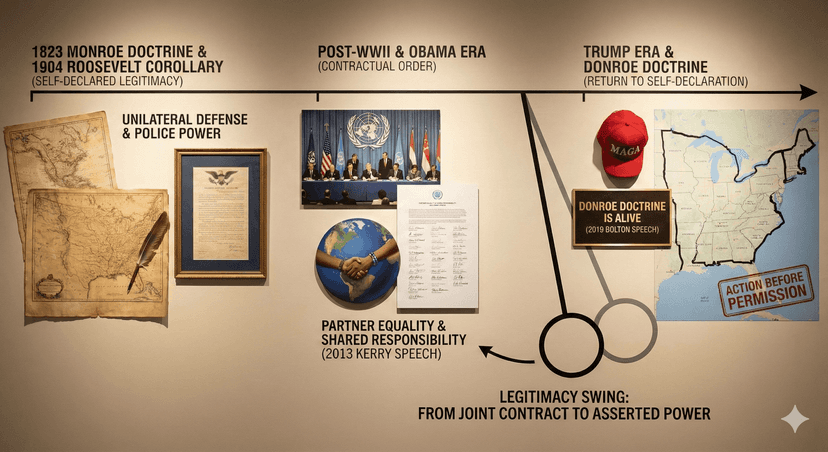
The Donroe Doctrine is often dismissed as “values conflict” or strongman nostalgia. Viewed over a longer arc, however, it represents a re-selection of legitimacy sources—from the postwar contractual order of treaties, institutions, and procedures back toward an older, more direct self-assertive legitimacy, where power and security needs justify action.
The Monroe Doctrine of 1823 was defensive: Europe was to cease expansion in the Western Hemisphere, justified by self-defense rather than international contract. Theodore Roosevelt’s 1904 Corollary advanced this logic, granting the U.S. self-assigned police power to correct disorder, lowering the intervention threshold from resisting outsiders to enforcing order.
During the Cold War, this logic was instrumentalized under anti-communism. International law receded; security and ideological perimeter sufficed. The principle was clear: once an area is defined as vital to U.S. security, action precedes procedure, and justification follows action.
Obama attempted recalibration. In 2013, Secretary of State John Kerry declared at the OAS that “the era of the Monroe Doctrine is over,” emphasizing partnership and shared responsibility. Yet structural incentives persisted. When domestic politics demand immediate returns and global governance costs appear sunk, procedures are repriced.
Trump’s reversal was thus unsurprising. In 2018, he explicitly reaffirmed hemispheric exclusion at the UN; in 2019, Bolton declared the Monroe Doctrine “alive.” The point was not rhetorical aggression, but a re-anchoring of legitimacy in unilateral natural-rights claims: authority flows from power and security need, not consent or multilateral authorization.
Seen across its full century-long curve, the Monroe Doctrine clarifies the Donroe Doctrine’s deeper conflict: it is not merely rule-breaking, but a reversion to the question of where rules come from. Contractual order requires collective authorization; Donroe logic treats execution itself as legitimacy production. International order shifts from jointly signed contracts to individually asserted boundaries.
Chapter Four | The Invisible Balance Sheet: Misaligned Gains and Costs
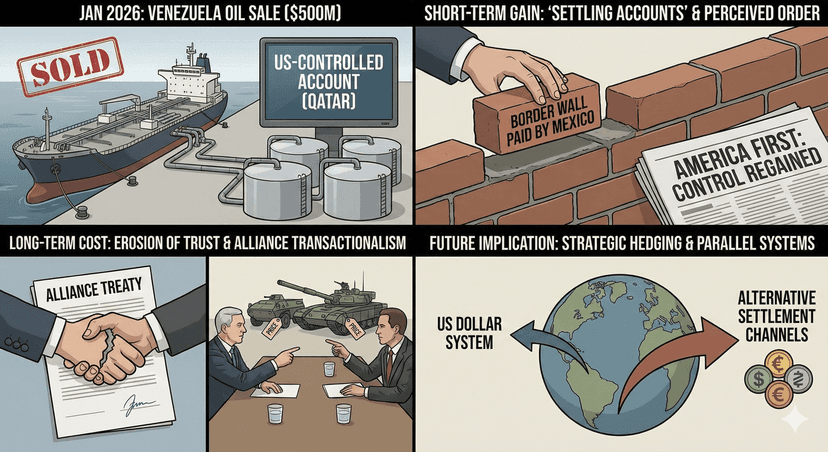
In mid-January 2026, the U.S. government completed its first supervised sale of Venezuelan oil—worth approximately $500 million—following an energy agreement with Venezuela’s interim authorities. According to U.S. officials, the proceeds are currently held in U.S.-controlled bank accounts in Qatar, marking a new phase of direct American management of Venezuelan energy assets.
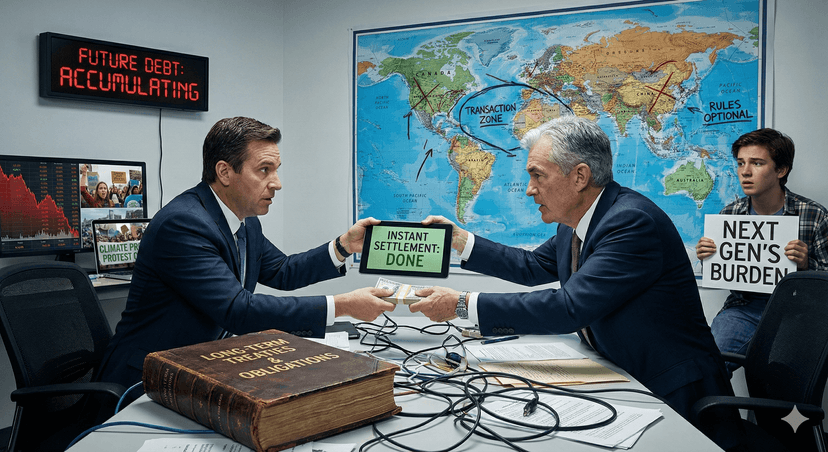
The Donroe Doctrine’s vitality lies in its short-term effectiveness and apparent cost efficiency. Through accounting sleight of hand, it realigns the time axis of gains and costs.
Gains: Breaking the “General Ledger” into Cash Settlement
The immediate effect is a strong sense of order recovery. Previously, border crises, energy dependence, and allied free-riding were framed as unavoidable globalization costs. Voters were told these were complex and required patience.
Donroe operators reject patience. Through unilateral extremes—tariffs, wall funding—they force peripheral issues center stage, creating a visible sense of control. For voters experiencing loss of agency, perception itself becomes psychological relief.
Further, responsibility is forcibly outsourced. Refugee costs, fentanyl enforcement, defense spending are shifted onto others. Mexico pays for borders; Europe boosts defense budgets. On paper, the burden appears shed.
Here lies a deep normative tension: for Rust Belt voters, cash settlement feels like justice—pain addressed now. For system-maintaining elites, it is dangerous overdraft—burning institutional reserves for short-term warmth. This explains elite backlash and grassroots resonance.
Costs: Reverse Pricing and Allied Hedging
The true cost is paid not in dollars, but in trust.
Postwar alliances rested on principle-based expectations: commitments precede calculation. Donroe logic erodes this. Tariffs and troops become bargaining chips; alliances shift from identity to project transactions.
Supporters celebrate this as forcing allies to pay. They underestimate learning curves. Seoul, Tokyo, Brussels now price proposals commercially: what’s the cost, the return, the trade? Security for fees. Tariff relief for access. Votes for exemptions.
Everything is priced. Law becomes leverage. Compliance becomes purchasable service. Allies hedge—quietly building alternative settlement systems or parallel trade agreements. This is not betrayal but rational risk management.
The alliance system does not collapse; it becomes expensive and friction-heavy. Gains accrue to current leaders; costs are amortized across future generations. It is a massive intertemporal cost transfer.
Chapter Five | The Skeleton of Strategy: “Rebuilding” or “Clearing the Field”?
Labeling Trump’s behavior as a doctrine is itself an intellectual shortcut. It implies blueprint construction. The reality is the opposite.
Trump is not a Vitruvian planner. He is a developer with a sledgehammer. He despises procedural ornamentation, lacks patience for institutional sequencing, and holds little reverence for abstract order. He is not a chessboard strategist, but a site foreman: if a wall obstructs, tear it down.
Viewing Donroe as a coherent theory overestimates institutional ambition and underestimates Trump’s time preference. He is a disruptor, not a builder. Hence the “unfinished project” aesthetic—and the TACO joke: Trump Always Chickens Out.
This is not incompetence but merchant cunning. Like “crossing the river by feeling for stones,” Trump crosses by feeling for profit. Donroe today is likely a nominal shell, written on a napkin, not parchment.
Strategic Contraction: Clearing the Backyard to Strike East
Beneath the chaos lies a cold red line.
If Monroe meant “the Americas for Americans,” Donroe means “the backyard for Americans.” Not defensive exclusion, but active clearance.
Latin America itself is not the prize. The real adversary is the world’s second-ranking power. Russia is downgraded; Iran is regional noise. America can no longer afford multiple high-burn fronts.
Donroe is strategic stop-loss: abandon Europe’s “dilettantes,” cut Ukraine’s “bottomless pit,” retreat to the Western Hemisphere, consolidate resources, then strike east from a secure base.
This is not isolationism—it is a boxer drawing back before a punch.
Yet personal vanity intrudes. Greenland, strategically marginal, reveals the doctrine’s weakness: personal ambition overrides systemic logic. Donroe often serves short-term political spectacle rather than long-term state rationality.
Disaggregated, the structure is clear:
* America First: value prioritization
* National Security Strategy: competitive narrative
* Donroe Doctrine: low-cost execution manual
It is not a new empire plan, but a refusal to keep paying for the old one.
Chapter Six | The Endgame Question: Limits, Counterweights, Evolution
Every strategy has limits. As Donroe becomes routine, it faces diminishing returns and systemic backlash.
Leverage Fatigue
Repeated pressure breeds immunity. Supply chains shift from “Just in Time” to “Just in Case.” Payment systems decentralize. Adversaries coordinate. Uncertainty becomes priced in.
To maintain effect, pressure must escalate—raising friction and miscalculation risk.
Imitation Effects
The greatest danger is not resistance, but emulation. Regional powers learn that legitimacy can be seized through surgical action and narrative closure. International politics devolves from rules to mimicry.
Soft Constraints and Hybridization
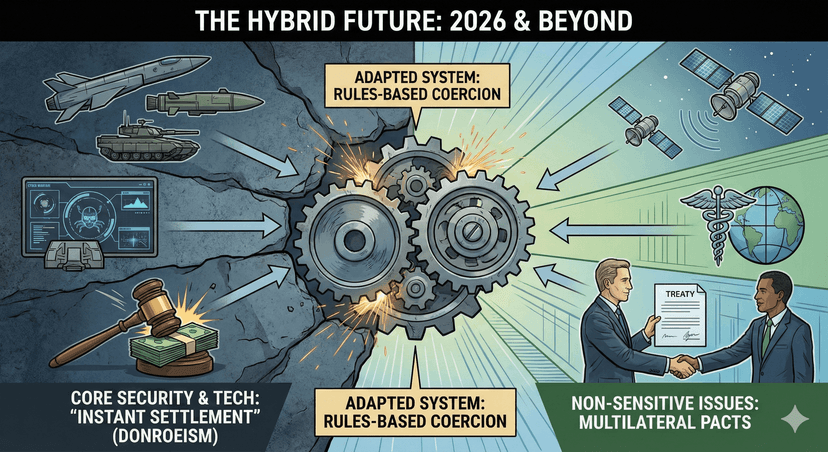
Markets, legislatures, and allies impose soft limits. Over time, institutions adapt, absorbing Donroe logic into proceduralized coercion—fast-trigger clauses, legalized exceptions.
The future is hybrid: cash-settlement power politics in core security domains; contractual multilateralism in low-sensitivity areas.
Conclusion | A Bitter Medicine Still Cooking
The Donroe Doctrine is not a historical detour, but a withdrawal symptom of over-financialized globalization.
As Washington trades the lighthouse for the abacus and revolver, it grows less graceful and more dangerous. Critics call this hegemonic decline. It may be deleveraging—cashing in moral overvaluation to make a final wager.
We are entering a disenchanted era. Donroe’s role is not what it builds, but what it cuts open. It forces states to confront an old truth: international order is not contract execution, but power equilibrium.
The marker-defaced map was not madness—it was a draft.
In this world, no IOUs can be rolled indefinitely. Every claim requires immediate force backing.
For the second-ranking power across the ocean, this is the moment of greatest vigilance. Across the table now sits not a preacher, but a gladiator.
The dish is still cooking. The taste is bitter. But its real shock lies not in flavor—only in reminding a civilized world of a forgotten law: when promises fail, can you still flip the table and redefine the game?
The hourglass is shattered. The next contest is no longer about who is more gentlemanly—only about who survives.